Daylilies have
been hybridzed into a variety of shapes. Part of the delight
of viewing daylilies in a garden setting is the constrast
between the various sizes and forms. Below you will find
text and illustrations of some of the forms daylily flowers may
exibit.

Photo by Tim Fehr, used
with permission. Cultivars: SPLENDID
TOUCH (L) and LONG
STOCKING (R) (Stamile)
Circular -- When viewed from the front
of a bloom, the flower appears
round. Segments tend
to be short, wide and stubby, and generally
overlap, giving a full appearance. See also: Recurved

Photo by Tim Fehr, uesd with
permission. Cultivar: CUSTARD
CANDY (Stamile)
Double -- This form has more than six segments. Double
daylilies, like single daylilies,
come in differing forms. For example: The extra
segments may appear as a tuft in the middle
of the flower. This is often referred to as
a "peony-type"
double. They may appear as a second layer of segments on
top of the normal six, forming two blooms in one - or a "hose-in-hose" effect.
They may appear as irregular or asymmetrical extra petaloids.

Photo by Tim Fehr, used with
permission. Cultivar: CONDILLA (Grooms
1977)
Flat -- When viewed from side of bloom,
flowers are perfectly flat except for the concave throat.

Photo by Rebecca Board, used
with permission.
Informal -- When viewed from front of bloom,
flower segments have no definable shape. Segment
placement may be irregular, widely spaced or
floppy.
Polytepalous --
Defined as "having extra whole tepals (sepals and petals)
in the two tepal whorls of a flower, i.e., more than
the normal three sepals (usually four or five) in
the outer whorl and more than three petals (usually
the same number as sepals) in the inner whorl." The
word "polytepalous" as adopted by the American
Hemerocallis Society applies to a condition recognized
in botanical language as polymerous.
Recurved -- When
viewed from side of bloom, flower segments flare,
but ends of segments roll or tuck under.
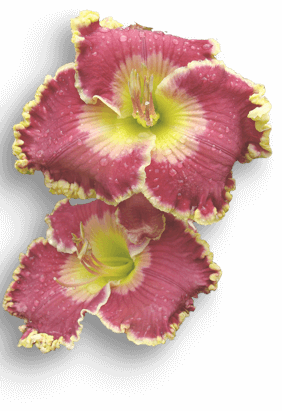
Ruffled -- When viewed from front of bloom, flower
segments have ruffles along the edges. Ruffles take many
forms; they may be tightly crimped, laced, knobby, or wavy.

Photo by Tim Fehr, used with
permission. Cultivar: SPLENDID
TOUCH (Stamile 1994)
Spider -- A flower whose segments have
a length-to-width ratio of at least 4 to 1
(i.e., 4:1). Length is measured with the segment
fully extended. Width measurement is taken
as the flower grows naturally.
Spider variant (no
longer a valid term!) -- Segment length-to-width
ratio must be at least 4 to 1 (i.e., 4:1) but less
than 5:1. Length is measured with the segment fully
extended. Width measurement is taken as the flower
grows naturally. This ratio was recently merged into
the spider classification.

Photo by Tim Fehr, used with
permission. Cultivar: LONG
STOCKING (Stamile, 1997)
Star -- When viewed from front of bloom,
flower segments tend to be long and pointed.
There is space between the segments, and the
shape looks like a three-pointed or six pointed
star.

Photo by Brian Mahieu, used
with permission. Seedling:
HOOD COLLEGE x H. Citrina
Triangular -- When viewed from the front
of the bloom, the flower segments form a
triangle. The sepals generally recurve.
Trumpet -- When viewed from side of bloom, flower form
resembles a true lily. Segments rise from throat in an
upward pattern with little flare.

Photo by Brian Mahieu, used
with permission.
Unusual
form -- The newest registration class
includes crispate (pinched, twisted or quilled floral
segments); cascading (narrow
curling or cascading segments); and spatulate (segments
markedly wider at the end like a kitchen spatula.)
Its definition states: "The Unusual Form"
class is based exclusively on form, not on color or color
patterns. The flower must have distinctive petal or sepal
shapes, or a combination of both.
|