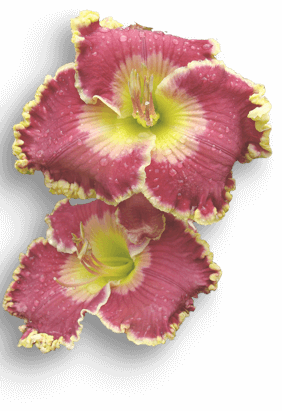
A class
of daylilies based exclusively on
form, not on color or color patterns. An Unusual Form must display
Unusual Form characteristics on at least 3 petals or
3 sepals.
Unusual
Forms is made up of 3 types of flowers, based exclusively
on their tepal (petal and sepal) shapes. These include: Crispate, Cascade and Spatulate forms.
1. Crispates -
The cross section of a daylily tepal resembles a corrugated
box, smooth on top and bottom separated by the "corrugated" center.
If, for example, the sun warms the cells on the upper layer
of the tepal more quickly than it does those on the lower layer,
they expand more rapidly than the cells on the lower layer
and therefore cause the tepal to twist fold or curl.
There are
three categories of Crispates:
Pinched
Crispates:
Definition; Pinching - Floral segments have sharp folds
giving a pinched or folded effect.

|

|
This
is the perfect example of a Pinched Crispate.
Petals are severely pinched or folded, with
the crease running back to the throat. The
sepals are nicely curled.
FIRE
ARROW - Webster.
Photo
by Richard Webster, used with permission. |
This
is a Pinched Crispate; even though the pinching
occures only on the outer 1/3 of the petal,
it is clearly pinched. That qualifies it as
a Pinched Crispate.
DUNE
NEEDLEPOINT - Pauley
Photo
by Bob Schwarz, used with permission. |
Twisted/Curled
Crispates
Definition: Twisting - Floral segments present a corkscrew
or pinwheel effect
|
The
top and lower right petal and bottom sepal
show the twisting typical of this type of
Unusual Form. Notice the distinct curling
of the other two sepals.
HURRICANE BOB
- Schwarz.
Photo
by Bob Schwarz, used with permission. |
Quilled
Crispates
Definition:
Quilling - Floral segments turn upon themselves along
their lengths to form a tubular shape.
|
The
sepals on this flower show the folding back
along the length of the segment that characterizes
this Unusual Form.
QUIRKY - Couturier
Photo by Geraldine Couturier, used with permission. |
2. Cascades Definition:
Cascading/Curling - Narrow florals segments with pronounced
curling or cascading (like in a waterfall) segments which revolve
upon themselves in the manner of a wood shaving.
|

The
tepals of a Cascade should really cascade like a
waterfall. |
The
straplike segments of this flower are examples of what
a cascade should look like. ORCHID
CORSAGE, Saxton.
Photo
by Bob Schwarz, used with permission. |
The
floral segments here descend nearly to where the tepals
separate at the base of the blossom. ORCHID
CORSAGE
Photo
by Bob Schwarz, used with permission. |
3. Spatulates Definition:
Floral segments markedly wider at the end like a kitchen
spatula.
|

The
petals are Spatulate. The sepals are partially Quilled
and Curled at the tips. ASTERISK,
Lambert. |
This
is a perfect example of the Spatulate form, long petals
with the widest part of the floral segment more than
half way from the center. SPOONER,
Wilson.
Photo
by Casey Schott, used with permission. |
Photo
by Bob Schwarz, used with permission. |
Unusual
Forms may bloom as pure examples of their kind, but very
often they combine more than one feature.
|
|
Twisted
Cascade: - puts a twist into the Cascade form. It is
an example of the fact that Unusual Forms often display
more than one UF characteristic.
LOLA BRANHAM,
Burkey
Photo by Clayton Burkey, used with permission. |
Spatulates
often reflex (curl back on themselves) This is a reflexed
Spatulate. It is also a Cockeral as the three quilled
sepals show.
LAVENDAR
HANDLEBARS, Roberts
Photo
by Bob Schwarz, used with permission. |
Many Unusual Forms are variable, displaying different forms or
combinations of forms each day they open.
|
|
Unusual
Forms may bloom as pure examples of their kind, but
very often they combine more than one feature. |
Here
this cultivar blooms as a Pinched Crispate. This is
a Variable Crispate.
ROSY
LIGHTS, Wilson |
Here
it displays Twisting, Curling, Quilling, and Pinching. |
|